
TL;DR
- Annotation tools for LLM evaluation and training data creation are now two different product categories, not one
- Human-in-the-loop LLM evaluation catches tone, safety, and domain errors that automated scorers miss
- Label Studio, SuperAnnotate, Labelbox, and TaskMonk cover the annotation and domain-training layer
- Braintrust, Argilla, and similar eval platforms cover the trace-and-scoring layer that sits on top
- Picking the wrong layer for your use case is the most common and most expensive mistake teams make
Search "annotation tools for LLM evaluation" and you get two answers pretending to be one. Half the results are eval-and-observability platforms: they score what a model already produced and stop there. The other half are labeling platforms: they build training data and treat evaluation as an afterthought. Almost none do both, which is why most teams end up buying twice, once for eval and once for training, without realizing the split until the second procurement cycle.
Our own text annotation platform is built to do both, scoring chat responses and building the training set behind them, which is closer to the exception than the rule. This guide maps the rest of the market by camp, so you know which one you are actually buying before you end up shopping twice.
How annotation changed in the LLM era
Annotation used to mean one thing: a person looks at a piece of data and applies a label. A bounding box on an image. A sentiment tag on a review. The label became training data, full stop.
LLMs broke that clean separation. Now a person might be labeling a training example, scoring a model's output against a rubric, comparing two responses to build a preference pair, or flagging a hallucination in a live production trace. All four get called "annotation" in vendor marketing, and each needs a different tool, reviewer skill set, and data pipeline.
The practical effect: a search for LLM data labeling tools now returns a mix of classic labeling platforms, eval-and-observability tools with an annotation feature bolted on, and RLHF-specific reviewer marketplaces. Picking based on brand recognition instead of job fit is how annotation programs quietly die within two quarters.
Why human-in-the-loop annotation still matters despite generative AI
It is fair to ask why teams still need people in the loop when generative models can grade their own outputs. The honest answer: LLM judges catch what they were built to catch, and stay blind to everything else.
A judge trained to score factual accuracy will happily pass a technically correct response that is tone-deaf or missing context a domain expert would flag immediately. Judges also drift. A rubric that matched production traffic three months ago stops matching it as edge cases shift, and nobody notices until a spot-check turns up the pattern.
Human review does four things automation cannot do alone: discover what to measure before a scorer exists, produce the golden dataset the scorer is measured against, handle quality dimensions like tone that resist automation, and recalibrate the judge when drift creeps in. Skip the human step and you are trusting a rubric nobody has checked against reality in months.
Pro tip: Run a monthly spot-check where a domain expert scores 50 recent outputs blind, without seeing the automated judge's score first. As a rule of thumb, if human and judge agreement drops below roughly 80%, the rubric needs work before you trust another quarter of automated scoring.
Annotation for training vs annotation for evaluation (two different jobs)
This is the distinction most comparison articles skip, and it is the one that actually decides which tool you buy.
Annotation for training builds the dataset a model learns from. A domain expert labels entities in legal contracts, tags intents in support tickets, or rates response pairs for a reward model, and the output is structured training data fed into a fine-tuning or RLHF pipeline. This work rewards annotator domain depth, consistent rubrics, and strong QC across volume. Our document annotation work follows exactly this pattern for contract and form-heavy datasets.
Annotation for evaluation scores what a model already produced. A reviewer reads a live output, checks it against a rubric, and the score feeds a judge calibration set or regression test rather than new training signal. This work rewards reviewers who understand the production context and tools that show the full trace, not an isolated output.
Our own breakdown of how a labeling platform streamlines this split goes deeper into where teams usually get the two jobs tangled. The two jobs share a rubric-and-reviewer skeleton, which is why vendors blur them in their marketing. But a tool optimized for building a 50,000-row training set is usually a poor fit for scoring 200 production traces a week, and vice versa. Ask which job you are actually hiring the tool for before you shortlist anything.
What to look for (HITL evaluation and domain-training criteria)
The criteria differ depending on which job from the section above you are solving, but a few apply to both.
For domain-specific AI model training, look for affinity-based routing so tasks land with annotators who actually know the domain, not a generalist pool. Look for multi-stage QC, a second reviewer, a majority-vote step, or both, rather than a single pass with no check. And look for support for the data types you actually have, since our multimodal annotation work has shown how often teams underestimate this until PDFs and screenshots start arriving mixed with plain text.
For human-in-the-loop LLM evaluation specifically, look for trace-level visibility so a reviewer sees the full context a model saw, inter-annotator agreement reporting per criterion, and a direct write-back path from reviewed labels into a dataset or judge calibration set. Labels that dead-end in a CSV export never actually close the loop.
Compliance matters more than either list suggests on paper. If reviewers touch PHI, financial records, or anything under GDPR, a platform's SOC 2, HIPAA, or ISO 27001 posture determines whether you can legally run the workflow at all.
The best annotation tools for HITL LLM evaluation and domain-specific training
These platforms sit primarily in the annotation-and-training layer: they build and manage the labeled data your models learn from, and several now support evaluation-style review on top. The differences show up less in what each one can technically do and more in who it was actually built for.
TaskMonk: Most teams on this list make you choose: build training data here, review model outputs somewhere else. TaskMonk is built so the same platform does both, which means one workforce, one QC system, and one place to look when a stakeholder asks how confident you actually are in a number. Reviewers score chat responses and rank preferences through a purpose-built widget instead of a rubric jammed into a text box, so evaluation data comes out clean enough to reuse as training data. A blind, running calibration check keeps both annotators and any judge model honest against ground truth automatically, instead of relying on someone remembering to run a quarterly audit. And when a rubric is genuinely ambiguous, reviewers can flag it and get an answer before they submit, not after a QC rejection three days later. That combination, plus compliance coverage built for regulated industries (SOC 2, ISO 27001, HITRUST, HIPAA, GDPR), is why teams doing domain-specific AI model training tend to land here instead of stitching two vendors together.
Label Studio: is the top open-source pick for a reason: it handles text, image, audio, video, and time-series data under one roof and is fully self-hostable on the Community edition. What it is not is purpose-built for LLM review. Its rubric primitives (star ratings, span highlights, free-text feedback) got bolted onto a tool with computer-vision roots, so scoring a chat response works but feels retrofitted rather than native, and project management stays thin on the free tier.
SuperAnnotate: earns its keep on QA discipline rather than breadth: multi-level automated QA, vector-powered dataset search, and disagreement analysis between human reviewers and automated scorers, all wrapped in a customizable UI builder across text, image, video, audio, and PDF. Teams running large, heavily audited mixed-media pipelines get more out of it than teams that just need a lightweight reviewer queue.
Labelbox: made a genuinely clean pivot out of computer vision. Foundry, its LLM-focused product, runs LLM-as-judge experiments against a labeled golden set inside the same platform, and the rubric editor and built-in inter-annotator agreement reporting are mature enough to trust. The tradeoff is platform weight: teams that only want a simple rubric-and-queue setup will feel like they bought more system than the job needs.
Prodigy: takes the opposite bet. Built by the spaCy team, it is lightweight, developer-centric, and runs locally, which matters for teams with strict data residency requirements doing fast, iterative NLP work. It was never built for a managed workforce or a reviewer hierarchy, and stretching it to cover either shows quickly.
LLM evaluation platforms worth knowing (the complementary layer)
These platforms sit closer to the evaluation and observability layer. They live next to production traces and automated scorers, and human review is one feature among several rather than the core product.
Braintrust. An end-to-end eval and observability platform where human review sits inside the same system as tracing, LLM-as-a-judge scoring, and CI/CD quality gates. Reviewers see the full execution trace, not just the final output, which matters for debugging agents. Its annotation surface is intentionally lighter than a dedicated labeling tool and is not built for managing a large workforce or a bulk training-data program.
Argilla. Apache 2.0 and HuggingFace-backed, Argilla stays focused on rubric-first, IAA-first annotation for LLM outputs rather than trying to be an observability platform too. Teams already in the HuggingFace ecosystem get a tight Python SDK and clean dataset push to the Hub. Pulling production traces in takes custom export work, so it pairs best with a separate trace store.
Galileo AI. Focused on LLM judge reliability itself: bias detection and consistency analysis for automated scorers, plus sub-200ms evaluators for production-grade scoring. It fits human-in-the-loop work at the calibration step, flagging where a judge is unreliable and needs a human override. Assignment and triage queues are less developed than the judge-optimization tooling.
The pattern here: strong on connecting human labels to traces and scorers, thinner on the workforce infrastructure a large domain-training program needs. Most teams pair one tool from this layer with one from the annotation layer above rather than expecting either to do both jobs.
Comparison table
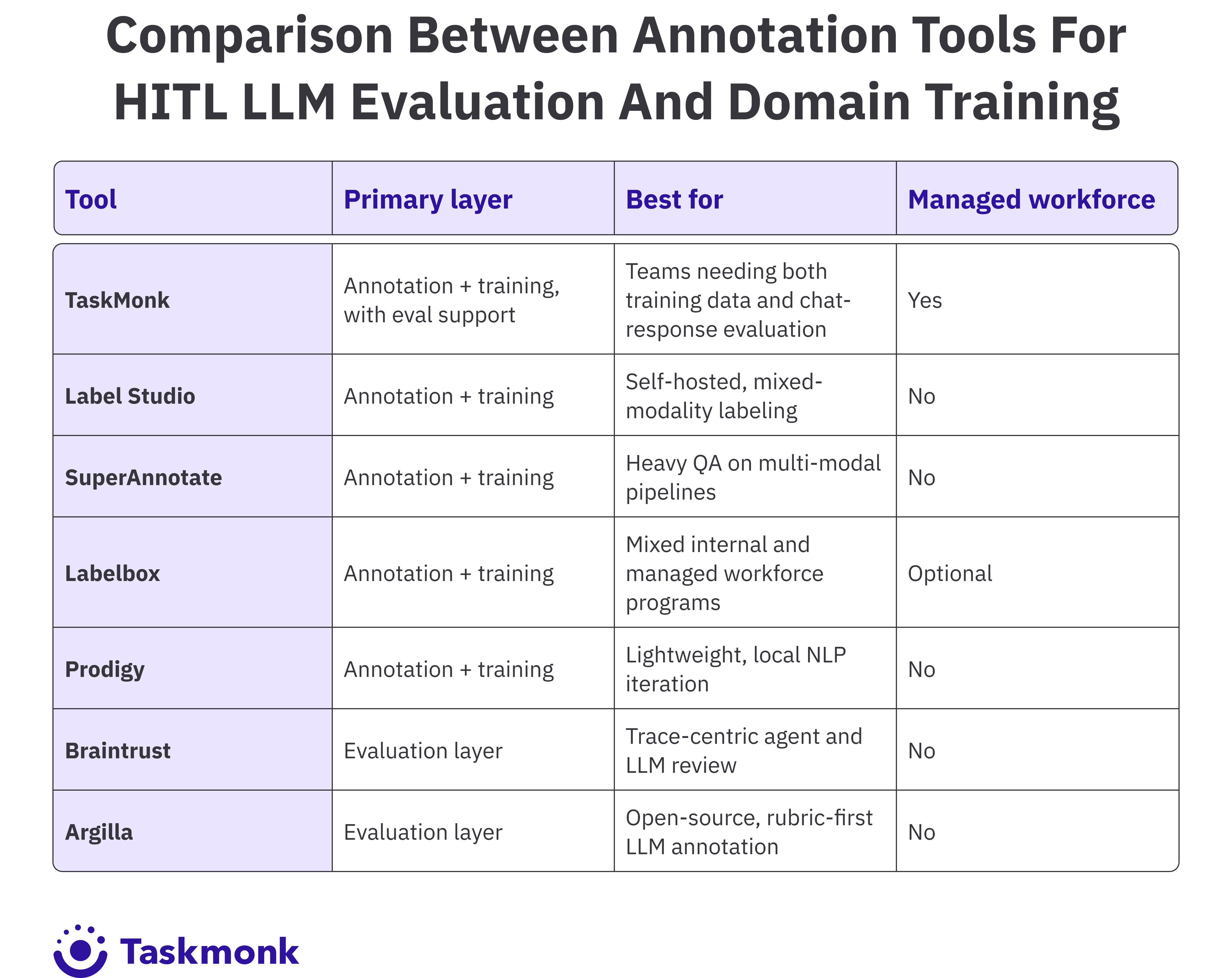
If the work spans multiple modalities today, text now and audio or video next quarter, pick a platform built for that from the start. Our RLHF-specific annotation work covers this tradeoff for preference-labeling programs specifically.
Common pitfalls when standing up a HITL evaluation workflow
Skipping inter-annotator agreement is the most common mistake. A labeled dataset with no IAA measurement is a dataset nobody has checked for consistency. As a common rule of thumb, a Cohen's Kappa below roughly 0.7 on a criterion signals the rubric is ambiguous enough to bake noise into anything trained on it.
Random sampling instead of targeted sampling wastes reviewer hours on easy cases that were never going to fail. Route the outputs your automated judge is least confident about to humans, and let the judge handle what it already scores well.
Treating annotation as a one-time setup rather than an ongoing discipline is how programs decay. A rubric well calibrated in Q1 quietly stops matching Q3's failure modes as production traffic drifts. Re-run agreement checks on a schedule, not just when something breaks visibly.
Buying a managed workforce when the real bottleneck is domain expertise, not volume, also wastes budget. A marketplace of generalist reviewers will not outperform three domain experts on a legal or clinical task no matter how many labelers you add.
Domain-specific model training (the second half of your title)
Domain-specific model training deserves its own attention because it is where HITL evaluation and classic annotation actually meet. A general-purpose LLM is competent at almost everything and expert at very little. Fine-tuning a model on domain examples is how teams get accuracy a general model cannot reach on narrow, high-stakes tasks.
The annotation work behind this differs from generic labeling in one specific way: annotators need to be the domain experts, not just trained on a rubric one wrote. A radiologist reviewing chest X-ray annotations catches things a generalist following a checklist will miss, and the same holds for a tax attorney reviewing contract clauses. This is why affinity-based routing exists as a platform feature rather than a nice-to-have: it puts the right expert on the right task at scale.
Once the domain dataset exists, the same reviewers who built it are usually the best people to evaluate the fine-tuned model's outputs too, since they already know what a good answer looks like. This is where the training and evaluation layers start feeding each other.
How TaskMonk handles HITL annotation for LLM evaluation
Most teams find out the hard way that a generic labeling form cannot capture what "good" looks like for a chat response, and that a tool built for production trace review alone cannot manage a serious training-data program. TaskMonk sits in the gap between those two problems, which shows up in three places once teams actually start using it.
The first is what reviewers see. Scoring a chat response or ranking model outputs happens through a widget built for exactly that job, so the data that comes out is structured enough to feed straight into training instead of needing a cleanup pass first.
The second is trust in the numbers. A blind, running calibration check keeps both human annotators and any judge model honest against ground truth automatically, so "is our accuracy real" stops being a question someone has to manually audit for. The third is speed to a clean label. When a rubric is ambiguous, reviewers can get it resolved before they submit rather than after a QC rejection days later, and when a rejection does happen, there is a documented back-and-forth instead of a black box.
One workspace covering text, image, video, audio, and LiDAR also means LLM and AI agent projects do not need to stitch together separate tools when a single evaluation pipeline has to handle a screenshot, a voice clip, and a document in the same review batch.
None of that is theoretical. TaskMonk has processed 480 million-plus tasks across 6 million-plus labeling hours, supports 10-plus Fortune 500 clients, and holds a 4.6 out of 5 rating on G2, volume that comes from real production programs, not a demo environment.
If your team is weighing whether to build a domain-training program, an evaluation review queue, or both, TaskMonk's annotation services team can walk through your actual data and rubric before you commit to a platform.
Conclusion
The cost of picking the wrong layer here is not obvious until months in. A team that buys an evaluation-only tool for a bulk training-data program discovers it has no workforce, no QC hierarchy, and no way to scale past a handful of internal reviewers. A team that buys a heavyweight annotation platform for a lightweight trace-review job spends months on setup for a use case that needed a queue and a rubric, not an enterprise labeling program.
The teams that get this right start by naming the actual job: are we building training data, or are we scoring what a model already produced? That answer, more than any feature comparison, determines which half of this market you should be shopping in. From there, the criteria in this guide, domain fit, IAA reporting, write-back paths, and compliance posture, do the rest of the filtering, whether that filter lands on TaskMonk or somewhere else on this list.
Annotation tools for LLM evaluation will keep splitting into more specialized categories as the market matures. The teams that treat this as an ongoing discipline rather than a one-time procurement decision are the ones whose models actually improve quarter over quarter, instead of plateauing on a judge nobody has recalibrated since launch.
Frequently asked questions
Is human-in-the-loop annotation still necessary if I already use an LLM judge?
Yes, for anything where tone, safety, or domain correctness matters. A judge only catches what its rubric was built to catch, and rubrics drift as production traffic changes. Most mature teams route a sample, or the cases the judge is least confident about, to human reviewers on a regular schedule.
What is the difference between annotation for training and annotation for evaluation?
Training annotation builds the dataset a model learns from, usually at higher volume with a focus on throughput and QC. Evaluation annotation scores outputs a model already produced, tied to a specific trace, feeding a judge calibration set rather than new training signal. They share a rubric-and-reviewer structure but need different tooling.
How do I know if my HITL rubric is actually working?
Check inter-annotator agreement per criterion, not just an overall score. Cohen's Kappa for two reviewers or Krippendorff's Alpha for more is the standard measure. A result below roughly 0.7 on any criterion means that part of the rubric is ambiguous enough that reviewers are effectively guessing.
Do I need a managed annotator workforce or can my internal team handle this?
It depends what is scarce. If the constraint is domain expertise, your internal team or a specialized partner usually outperforms a generalist marketplace. If the constraint is pure volume with a relatively objective rubric, a managed workforce with strong QC scales faster. Many programs land on a hybrid.
Can the same tool handle both domain-specific model training and LLM evaluation?
Some can, but check which job the platform was built for first. Platforms built around workforce management and QC hierarchies, TaskMonk, Labelbox, and SuperAnnotate among them, tend to add evaluation-style review reasonably well. Platforms built around tracing and scorers tend to struggle when asked to run a large training-data program.
How often should we recalibrate our LLM judge against human labels?
Monthly is a reasonable default, more often for fast-changing user behavior or high regulatory stakes. Pull a fresh sample, have a domain expert score it blind, and compare against the judge's scores on the same items. A meaningful drop in agreement is the signal something has shifted.
What compliance certifications should an annotation vendor have for regulated industries?
At minimum, SOC 2 Type II as a baseline security assurance. For healthcare data, HIPAA and ideally HITRUST are non-negotiable. For EU user data, GDPR compliance is required, not optional. ISO 27001 signals a mature security program generally. Ask vendors for current audit reports rather than a claim on a website.