We did the heavy lifting in 2025. Here’s what it
added up to ->
View Details.

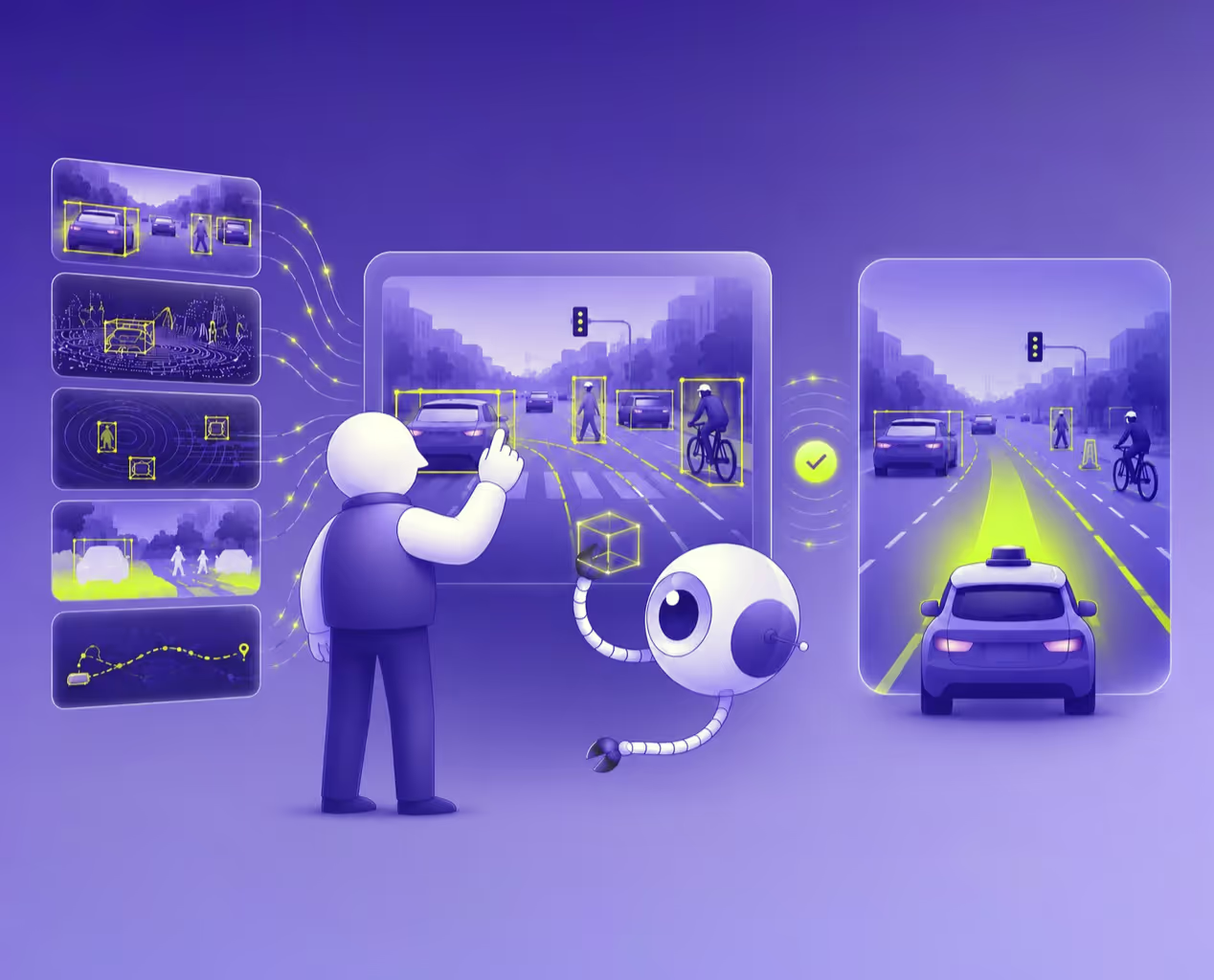
Taskmonk helps autonomy and ADAS teams curate, label, and QA multimodal sensor data at scale, so perception, prediction, and planning improve in real-world conditions.
TALK TO OUR EXPERTS
Build reliable autonomy datasets from raw sensor streams.
Features built for autonomous systems teams/

Multimodal sequence support
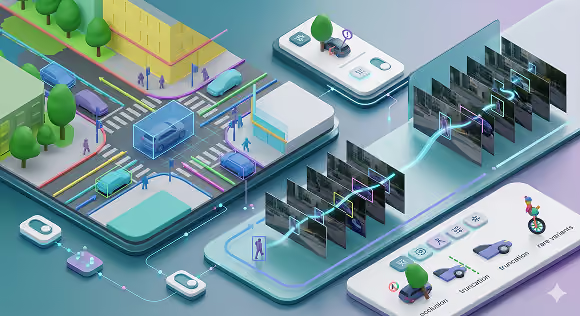
Work with synchronized camera and LiDAR sequences and metadata, enabling consistent context across frames so labels stay reliably aligned, reducing label flicker, mismatches, and missed cues during annotation.
Autonomy-ready annotation primitives
Support 2D, 3D, and temporal labels such as cuboids, polylines, segmentation, and tracking—allowing teams to capture diverse scene elements accurately. Attribute rules for occlusion, truncation, and rare variants improve labeling consistency in challenging scenarios.

Maker-checker QA workflows
Route tasks through labeling, review, and audit lanes with clear acceptance criteria and rework loops. This ensures that quality targets are consistently maintained as volume grows and more teams are added.

Consensus and escalation handling
Escalate ambiguous scenes to expert arbitration rather than forcing guesses, capturing rationale and examples to improve guidelines and prevent recurring disagreement patterns.

Edge-case curation and challenge queues
Slice data by weather, lighting, geography, and scenario tags to create targeted challenge queues. Prioritizing these long-tail queues improves model recall and reduces production blind spots, enhancing real-world model performance.

Versioned ontology and change control
Manage ontology updates with controlled releases, backward compatibility rules, and drift monitoring. This preserves comparability, ensuring training and evaluation sets remain aligned and meaningful across versions.
Use Cases of Data Annotation in Autonomous Systems
Explore how AI training data powers ADAS, robotics, drones, agriculture, and smart infrastructure with accurate labeling.
TALK TO OUR EXPERTS
.svg)
Autonomous vehicles and ADAS
Create perception and scene-understanding datasets with 2D, 3D, and sequence labels for detection, segmentation, tracking, lane detection, traffic light detection, and long-tail driving scenarios.

Warehouse and logistics robotics
Create navigation and safety behavior labels in dynamic aisles: identify obstacles, pallets, humans, forklifts, and intent cues to enable collision avoidance, routing, and efficient pick workflows.

Industrial robotics and automation
Provide precise manipulation and inspection labels in cluttered workcells: mark parts, tools, grasp points, occlusions, and defects under variable lighting and reflective surfaces.

Drones and aerial autonomy
Deliver object and terrain annotations from altitude: track, segment, and detect changes despite motion blur, perspective shifts, shadows, low light, and complex ground textures.
.svg)
Off-road and agriculture autonomy
Develop datasets for unstructured environments: segment terrain, define row boundaries, identify obstacles, and track equipment while handling dust, uneven ground, foliage, and seasonal variation.
.svg)
Smart mobility and infrastructure
Define road asset and event labels for monitoring and mapping, including lanes, curbs, signage, signals, construction zones, and anomalies, using consistent schemas across geographies.
Autonomous vehicles and ADAS
Create perception and scene-understanding datasets with 2D, 3D, and sequence labels for detection, segmentation, tracking, lane detection, traffic light detection, and long-tail driving scenarios.
Warehouse and logistics robotics
Create navigation and safety behavior labels in dynamic aisles: identify obstacles, pallets, humans, forklifts, and intent cues to enable collision avoidance, routing, and efficient pick workflows.
Industrial robotics and automation
Provide precise manipulation and inspection labels in cluttered workcells: mark parts, tools, grasp points, occlusions, and defects under variable lighting and reflective surfaces.
Drones and aerial autonomy
Deliver object and terrain annotations from altitude: track, segment, and detect changes despite motion blur, perspective shifts, shadows, low light, and complex ground textures.
Off-road and agriculture autonomy
Develop datasets for unstructured environments: segment terrain, define row boundaries, identify obstacles, and track equipment while handling dust, uneven ground, foliage, and seasonal variation.
Smart mobility and infrastructure
Define road asset and event labels for monitoring and mapping, including lanes, curbs, signage, signals, construction zones, and anomalies, using consistent schemas across geographies.
Autonomous vehicles and ADAS
Create perception and scene-understanding datasets with 2D, 3D, and sequence labels for detection, segmentation, tracking, lane detection, traffic light detection, and long-tail driving scenarios.
Warehouse and logistics robotics
Create navigation and safety behavior labels in dynamic aisles: identify obstacles, pallets, humans, forklifts, and intent cues to enable collision avoidance, routing, and efficient pick workflows.
Industrial robotics and automation
Provide precise manipulation and inspection labels in cluttered workcells: mark parts, tools, grasp points, occlusions, and defects under variable lighting and reflective surfaces.
Drones and aerial autonomy
Deliver object and terrain annotations from altitude: track, segment, and detect changes despite motion blur, perspective shifts, shadows, low light, and complex ground textures.
Off-road and agriculture autonomy
Develop datasets for unstructured environments: segment terrain, define row boundaries, identify obstacles, and track equipment while handling dust, uneven ground, foliage, and seasonal variation.
Smart mobility and infrastructure
Define road asset and event labels for monitoring and mapping, including lanes, curbs, signage, signals, construction zones, and anomalies, using consistent schemas across geographies.
Autonomous vehicles and ADAS
Create perception and scene-understanding datasets with 2D, 3D, and sequence labels for detection, segmentation, tracking, lane detection, traffic light detection, and long-tail driving scenarios.
Warehouse and logistics robotics
Create navigation and safety behavior labels in dynamic aisles: identify obstacles, pallets, humans, forklifts, and intent cues to enable collision avoidance, routing, and efficient pick workflows.
Industrial robotics and automation
Provide precise manipulation and inspection labels in cluttered workcells: mark parts, tools, grasp points, occlusions, and defects under variable lighting and reflective surfaces.
Drones and aerial autonomy
Deliver object and terrain annotations from altitude: track, segment, and detect changes despite motion blur, perspective shifts, shadows, low light, and complex ground textures.
Off-road and agriculture autonomy
Develop datasets for unstructured environments: segment terrain, define row boundaries, identify obstacles, and track equipment while handling dust, uneven ground, foliage, and seasonal variation.
Smart mobility and infrastructure
Define road asset and event labels for monitoring and mapping, including lanes, curbs, signage, signals, construction zones, and anomalies, using consistent schemas across geographies.
Autonomous vehicles first annotation types
Cover the annotation primitives autonomous vehicle and ADAS teams use most across perception and scene understanding.
.svg)
3D cuboids
Label vehicles, pedestrians, riders, and obstacles in 3D with orientation, size, and class-specific attributes, including occlusion (when objects are partially blocked from view) and truncation.

Polylines
Annotate lanes, curbs, road edges, and centerlines with topology rules to ensure geometry remains consistent across merges, splits, and intersections.

Segmentation
Create pixel-accurate masks for drivable areas, sidewalks, barriers, vegetation, and free space to train robust scene-understanding models.

Tracking across sequences
Maintain stable object IDs across frames by interpolating and reviewing to prevent ID switches, jitter, and drift.

Traffic lights and signs
Label lights and signs with state and attributes, covering rare variants, occlusions, night scenes, glare, and weather distortions.
3D cuboids
Label vehicles, pedestrians, riders, and obstacles in 3D with orientation, size, and class-specific attributes, including occlusion (when objects are partially blocked from view) and truncation.
Polylines
Annotate lanes, curbs, road edges, and centerlines with topology rules to ensure geometry remains consistent across merges, splits, and intersections.
Segmentation
Create pixel-accurate masks for drivable areas, sidewalks, barriers, vegetation, and free space to train robust scene-understanding models.
Tracking across sequences
Maintain stable object IDs across frames by interpolating and reviewing to prevent ID switches, jitter, and drift.
Traffic lights and signs
Label lights and signs with state and attributes, covering rare variants, occlusions, night scenes, glare, and weather distortions.
3D cuboids
Label vehicles, pedestrians, riders, and obstacles in 3D with orientation, size, and class-specific attributes, including occlusion (when objects are partially blocked from view) and truncation.
Polylines
Annotate lanes, curbs, road edges, and centerlines with topology rules to ensure geometry remains consistent across merges, splits, and intersections.
Segmentation
Create pixel-accurate masks for drivable areas, sidewalks, barriers, vegetation, and free space to train robust scene-understanding models.
Tracking across sequences
Maintain stable object IDs across frames by interpolating and reviewing to prevent ID switches, jitter, and drift.
Traffic lights and signs
Label lights and signs with state and attributes, covering rare variants, occlusions, night scenes, glare, and weather distortions.
Autonomous vehicles and ADAS
Create perception and scene-understanding datasets with 2D, 3D, and sequence labels for detection, segmentation, tracking, lane detection, traffic light detection, and long-tail driving scenarios.
Warehouse and logistics robotics
Create navigation and safety behavior labels in dynamic aisles: identify obstacles, pallets, humans, forklifts, and intent cues to enable collision avoidance, routing, and efficient pick workflows.
Industrial robotics and automation
Provide precise manipulation and inspection labels in cluttered workcells: mark parts, tools, grasp points, occlusions, and defects under variable lighting and reflective surfaces.
Drones and aerial autonomy
Deliver object and terrain annotations from altitude: track, segment, and detect changes despite motion blur, perspective shifts, shadows, low light, and complex ground textures.
Off-road and agriculture autonomy
Develop datasets for unstructured environments: segment terrain, define row boundaries, identify obstacles, and track equipment while handling dust, uneven ground, foliage, and seasonal variation.
.svg)
Curated datasets, not raw dumps
Build balanced batches across weather, lighting, road type, geography, and rare events.

Ground truth you can audit
Clear ontology, reviewer decisions, and change control to prevent label drift.

Reliable throughput
Operational SLAs for volume, cycle time, and quality targets.
Curated datasets, not raw dumps
Build balanced batches across weather, lighting, road type, geography, and rare events.
.svg)
Ground truth you can audit
Clear ontology, reviewer decisions, and change control to prevent label drift.
.svg)
Reliable throughput
Operational SLAs for volume, cycle time, and quality targets.
Why Choose Us for Autonomous AI Data Annotation
From project ownership to measurable quality and secure scaling, our workflows ensure consistent, reliable datasets for real-world AI systems.

End-to-end project management
We organize tasks, set clear rules, manage steps, and check quality through delivery. One person owns each project. We set weekly goals and offer clear reports in the platform.

Multimodal autonomy expertise
Teams trained on LiDAR, camera image sequences, object tracking, and rare or ambiguous scenarios called edge cases, calibrated using expert-reviewed gold standard tasks and specially designed challenge sets, so decisions stay consistent.
.svg)
Secure, scalable, cost-predictable
Single sign-on (SSO), role-based access control, Virtual Private Cloud (VPC) or on-premises deployment options, and zero-copy (direct) access to your data buckets—plus expandable workgroups (pods) and published rates that avoid hidden costs.

Quality you can measure
Maker-checker (two-step review), consensus (multiple agreement), and programmatic (automated) checks tied to KPIs for each object or class, so quality is visible, debuggable, and stable across dataset versions.
End-to-end project management
We organize tasks, set clear rules, manage steps, and check quality through delivery. One person owns each project. We set weekly goals and offer clear reports in the platform.
Multimodal autonomy expertise
Teams trained on LiDAR, camera image sequences, object tracking, and rare or ambiguous scenarios called edge cases, calibrated using expert-reviewed gold standard tasks and specially designed challenge sets, so decisions stay consistent.
Secure, scalable, cost-predictable
Single sign-on (SSO), role-based access control, Virtual Private Cloud (VPC) or on-premises deployment options, and zero-copy (direct) access to your data buckets—plus expandable workgroups (pods) and published rates that avoid hidden costs.
Quality you can measure
Maker-checker (two-step review), consensus (multiple agreement), and programmatic (automated) checks tied to KPIs for each object or class, so quality is visible, debuggable, and stable across dataset versions.
Autonomous systems annotation services
Expert execution services for autonomous vehicles and robotics, from pilot to scale.

Autonomous vehicle and ADAS datasets
Building on robust data foundations, we implement sequence labeling for detection, segmentation, tracking, lane detection, and traffic asset detection across diverse road conditions, tuned to reduce false positives and improve real-world performance.

Sensor fusion and sequence operations
We manage time sync, multi-view context, and sequence continuity to keep labels aligned across sensors, frames, and scenes.

Review, audit, and escalation ops
As data passes through quality gates, structured review lanes, audit sampling, and expert arbitration for ambiguity capture, rationale and guidelines improve, and disagreements don’t turn into label drift.

Dataset curation and edge-case queues
Following rigorous review, we curate batches using metadata and failure signals, then run long-tail queues for rare actors, unusual interactions, and safety-critical scenarios that drive model gains.

Export-ready delivery for ML pipelines
Finally, we ship clean, versioned datasets with consistent schemas and controlled releases, so training, evaluation, and regression sets remain comparable over time.
Autonomous vehicle and ADAS datasets
Building on robust data foundations, we implement sequence labeling for detection, segmentation, tracking, lane detection, and traffic asset detection across diverse road conditions, tuned to reduce false positives and improve real-world performance.
Sensor fusion and sequence operations
We manage time sync, multi-view context, and sequence continuity to keep labels aligned across sensors, frames, and scenes.
Review, audit, and escalation ops
As data passes through quality gates, structured review lanes, audit sampling, and expert arbitration for ambiguity capture, rationale and guidelines improve, and disagreements don’t turn into label drift.
Dataset curation and edge-case queues
Following rigorous review, we curate batches using metadata and failure signals, then run long-tail queues for rare actors, unusual interactions, and safety-critical scenarios that drive model gains.
Export-ready delivery for ML pipelines
Finally, we ship clean, versioned datasets with consistent schemas and controlled releases, so training, evaluation, and regression sets remain comparable over time.
Autonomous vehicle and ADAS datasets
Building on robust data foundations, we implement sequence labeling for detection, segmentation, tracking, lane detection, and traffic asset detection across diverse road conditions, tuned to reduce false positives and improve real-world performance.
Sensor fusion and sequence operations
We manage time sync, multi-view context, and sequence continuity to keep labels aligned across sensors, frames, and scenes.
Review, audit, and escalation ops
As data passes through quality gates, structured review lanes, audit sampling, and expert arbitration for ambiguity capture, rationale and guidelines improve, and disagreements don’t turn into label drift.
Dataset curation and edge-case queues
Following rigorous review, we curate batches using metadata and failure signals, then run long-tail queues for rare actors, unusual interactions, and safety-critical scenarios that drive model gains.
Export-ready delivery for ML pipelines
Finally, we ship clean, versioned datasets with consistent schemas and controlled releases, so training, evaluation, and regression sets remain comparable over time.
Autonomous vehicle and ADAS datasets
Building on robust data foundations, we implement sequence labeling for detection, segmentation, tracking, lane detection, and traffic asset detection across diverse road conditions, tuned to reduce false positives and improve real-world performance.
Sensor fusion and sequence operations
We manage time sync, multi-view context, and sequence continuity to keep labels aligned across sensors, frames, and scenes.
Review, audit, and escalation ops
As data passes through quality gates, structured review lanes, audit sampling, and expert arbitration for ambiguity capture, rationale and guidelines improve, and disagreements don’t turn into label drift.
Dataset curation and edge-case queues
Following rigorous review, we curate batches using metadata and failure signals, then run long-tail queues for rare actors, unusual interactions, and safety-critical scenarios that drive model gains.
Export-ready delivery for ML pipelines
Finally, we ship clean, versioned datasets with consistent schemas and controlled releases, so training, evaluation, and regression sets remain comparable over time.
FAQ
What is autonomous systems data annotation?
Autonomous systems data annotation involves labeling sensor data such as video, images, and LiDAR so that models can learn perception, tracking, and scene understanding for real-world operation.
What annotation types do you support for autonomous vehicles and ADAS?
We support 2D and 3D labeling, including 3D cuboids with attributes, polylines for lanes and curbs, semantic/instance segmentation, sequence tracking, and traffic assets.
How do you ensure quality at scale for safety-critical AI?
We use maker-checker workflows, audit sampling, consensus on ambiguity, temporal consistency checks for sequences, and versioned guidelines to prevent drift.
How is autonomous systems annotation priced?
Pricing depends on modality (video vs LiDAR), label type (cuboids vs segmentation), scene density, sequence length, and QA depth. We align pricing to clear output units and SLAs.
What does “ground truth” mean for autonomous vehicles?
Ground truth is the trusted reference labels used for training and evaluation. For autonomy, it must be consistent across sequences, sensors, and dataset versions to avoid regressions.
How do you handle rare scenarios and edge cases?
We curate long-tail queues using metadata and scenario tags, then escalate ambiguous cases to experts. This increases coverage for conditions that typically drive model gains.
Reach out to our team and
