


Top Video Object Tracking Algorithms in 2025: A Technical Deep Dive
TL;DR
Video object tracking algorithms combine object detection with data association to maintain object identities across frames.
Tracking systems typically include two components:
- A detection backbone (YOLO, SSD, Faster R-CNN)
- A data association method (Kalman filtering, IoU matching, or appearance embeddings)
Tracking approaches fall into two main categories:
- Single Object Tracking (SOT) – follows one initialized target
- Multi-Object Tracking (MOT) – tracks multiple objects simultaneously
The most widely used video object tracking algorithms in 2025 include:
For evaluating trackers, modern research increasingly favors HOTA (Higher Order Tracking Accuracy) over MOTA because HOTA measures detection and association performance independently.
Introduction
If you've ever run a detection model on a video and watched it produce independent detections on every frame, you've already seen the limitation of object detection. Detection answers one question: “What objects exist in this frame?”, Tracking answers the harder one:
“Is this the same object I saw 40 frames ago, and where is it going next?”
Without tracking, a computer vision system has no temporal memory. Every frame is processed independently.
Video object tracking algorithms solve this problem by linking detections across frames and maintaining consistent object identities over time. They enable systems to follow objects through motion, recover from occlusions, and generate trajectories that support downstream applications like behavior analysis, anomaly detection, and predictive modeling.
In modern computer vision pipelines, object detection and object tracking work together. Detection identifies objects, while tracking maintains their identity across time.
This guide explores the most important video object tracking algorithms used in 2025, from classical Kalman-filter trackers to modern transformer-based systems. We'll also examine how these algorithms work, their strengths and weaknesses, and where they are used in real-world applications. Let’s start first by understanding what video object tracking is.
What is Video Object Tracking?
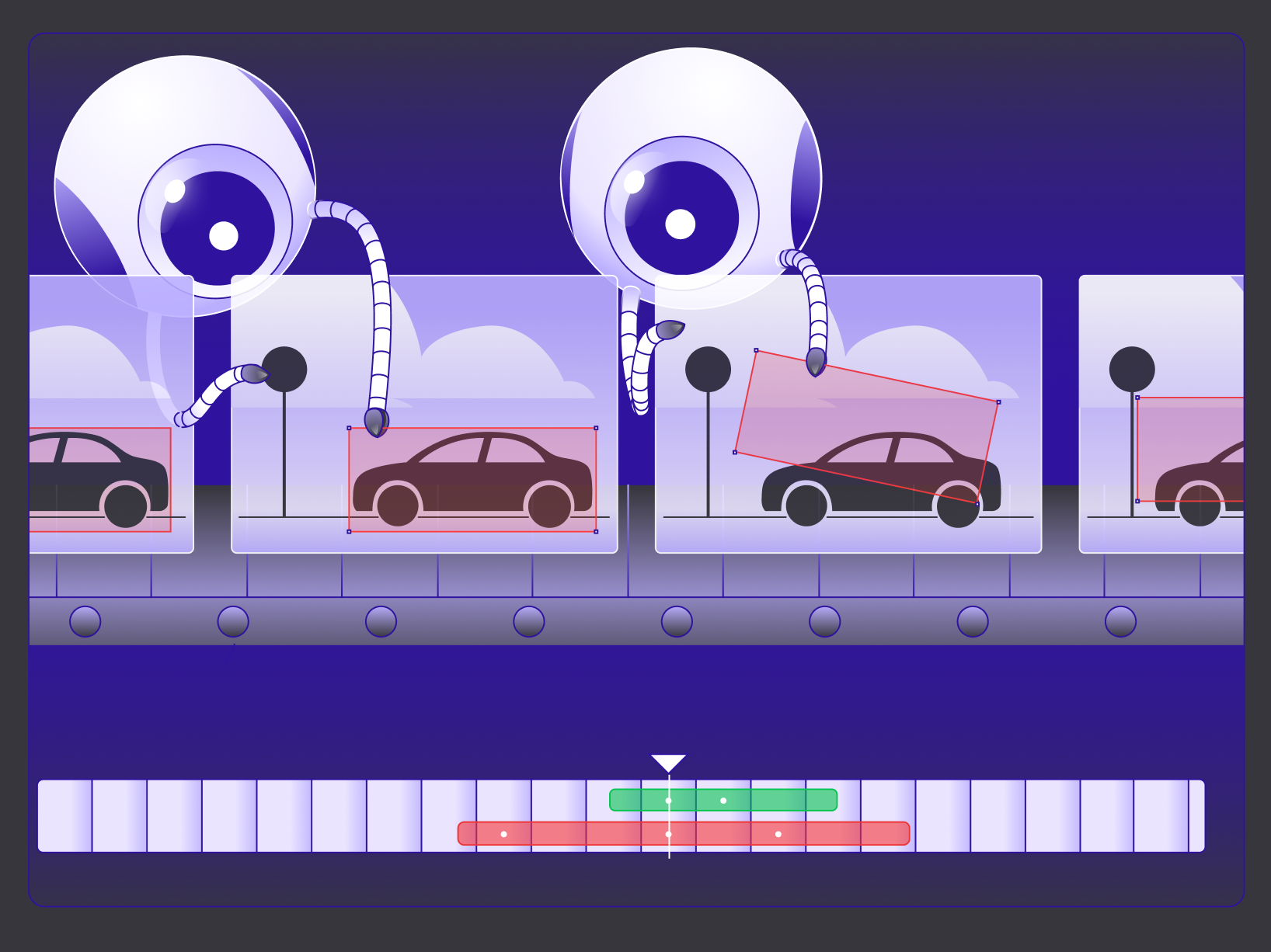
Video object tracking is a computer vision technique that detects objects in video frames and maintains their identity across time. While Object detection identifies objects in individual frames, Video object tracking connects those detections so the system knows which detections correspond to the same object across frames. In practice, tracking involves two main technical components.
State Estimation: The tracker predicts where an object will appear in the next frame. Most classical trackers use Kalman filters, which estimate motion using velocity and position.
Data Association: Once new detections appear, the tracker must determine which detection corresponds to which existing tracked object.
Common association methods include:
These mechanisms allow trackers to recover objects after occlusion and maintain consistent object identities.
Now that we understand how tracking works conceptually, the next question is which algorithms actually power modern tracking systems.
Different trackers solve the problem in different ways; some rely on classical motion models, while others use deep learning and transformer architectures. Let’s understand them:
Top Video Object Tracking Algorithms
Below are the most widely used video object tracking algorithms in 2025, ranging from classical methods to deep learning–based systems.
.png)
Benefits of Using Video Object Tracking Algorithms
Video object tracking enables capabilities that simple object detection cannot provide.
Persistent Object Identity: Each tracked object receives a consistent ID across frames. This allows systems to analyze movement trajectories and behaviour patterns.
Reduced Annotation Effort: Tracking enables annotators to label keyframes rather than every frame. The tracker propagates annotations between frames, significantly reducing labeling time. Tracking also reduces annotation effort. Instead of labeling every frame individually, annotators can label keyframes while the tracker propagates bounding boxes between frames.
If you're building datasets for tracking models, a structured video annotation workflow becomes essential. Our guide to video annotation for computer vision projects explains how teams design scalable labeling pipelines.
Temporal Consistency: Detectors often produce inconsistent results across frames due to lighting changes or motion blur. Tracking smooths these outputs and creates stable object trajectories.
Despite these advantages, tracking remains a difficult problem in real-world environments. Even state-of-the-art trackers struggle with several technical challenges, such as the following:

Challenges in Object Tracking
Even advanced trackers struggle with several real-world challenges.
- Occlusion: Objects may become temporarily hidden behind other objects or obstacles, making identity recovery difficult.
- Non-Linear Motion: Sudden direction changes can break the assumptions used by simple motion models.
- Camera Motion: Moving cameras create apparent motion for all objects in the frame, confusing trackers without camera-motion compensation.
- Scale Variation: Objects change apparent size as they move closer or farther from the camera.
- Domain Shift: Tracking algorithms trained on benchmark datasets often perform poorly in specialized environments such as aerial footage or medical imaging.
These challenges explain why tracking algorithms are carefully chosen depending on the application domain.
Let’s look at how video object tracking is used across different industries.
Applications of Video Object Tracking
Video object tracking supports many modern AI systems.
Autonomous Vehicles: Vehicles track surrounding agents such as pedestrians, cyclists, and other vehicles to understand dynamic environments. Autonomous driving systems often combine camera tracking with LiDAR-based perception to maintain object trajectories across sensors.
If you're working with multi-sensor datasets, this overview of best LiDAR annotation platforms explains how 3D perception pipelines are labeled and validated.
Sports Analytics: Tracking enables analysis of player movement, formations, and tactical strategies.
Surveillance and Retail: Tracking systems support crowd monitoring, queue management, and security analytics.
Medical Imaging: Tracking algorithms can follow surgical tools or track cellular movement in microscopy videos.
Robotics and Drones: Robots and drones use tracking for navigation, obstacle avoidance, and target following.
While algorithms are critical, real-world performance depends heavily on high-quality annotated datasets used to train and evaluate tracking models.
Scaling Video Object Tracking with a competent Data labeling infrastructure like TaskMonk
Training reliable trackers requires large volumes of accurately labeled video frames, especially in scenarios involving occlusion, dense scenes, and moving cameras.
A robust data annotation infrastructure like TaskMonk provides a world-class platform, along with human-in-the-loop computer vision annotation workflows designed to scale video annotation for AI teams.
Organizations use TaskMonk to:
The platform supports audio, video, LiDAR, DICOM and multimodal annotation pipelines, allowing teams to build high-quality datasets for computer vision systems.
Conclusion
Video object tracking algorithms have evolved significantly over the past decade, moving from classical filtering approaches to deep learning and transformer-based architectures.
Today’s systems must balance three competing factors: tracking accuracy, robustness to occlusion & real-time performance.
Algorithms such as ByteTrack and StrongSORT offer strong performance for real-time applications, while transformer-based approaches like MOTR provide powerful solutions for offline analysis.
Ultimately, the best tracker is the one that performs reliably on your specific dataset and operational environment.

FAQs
.png)
.png)
