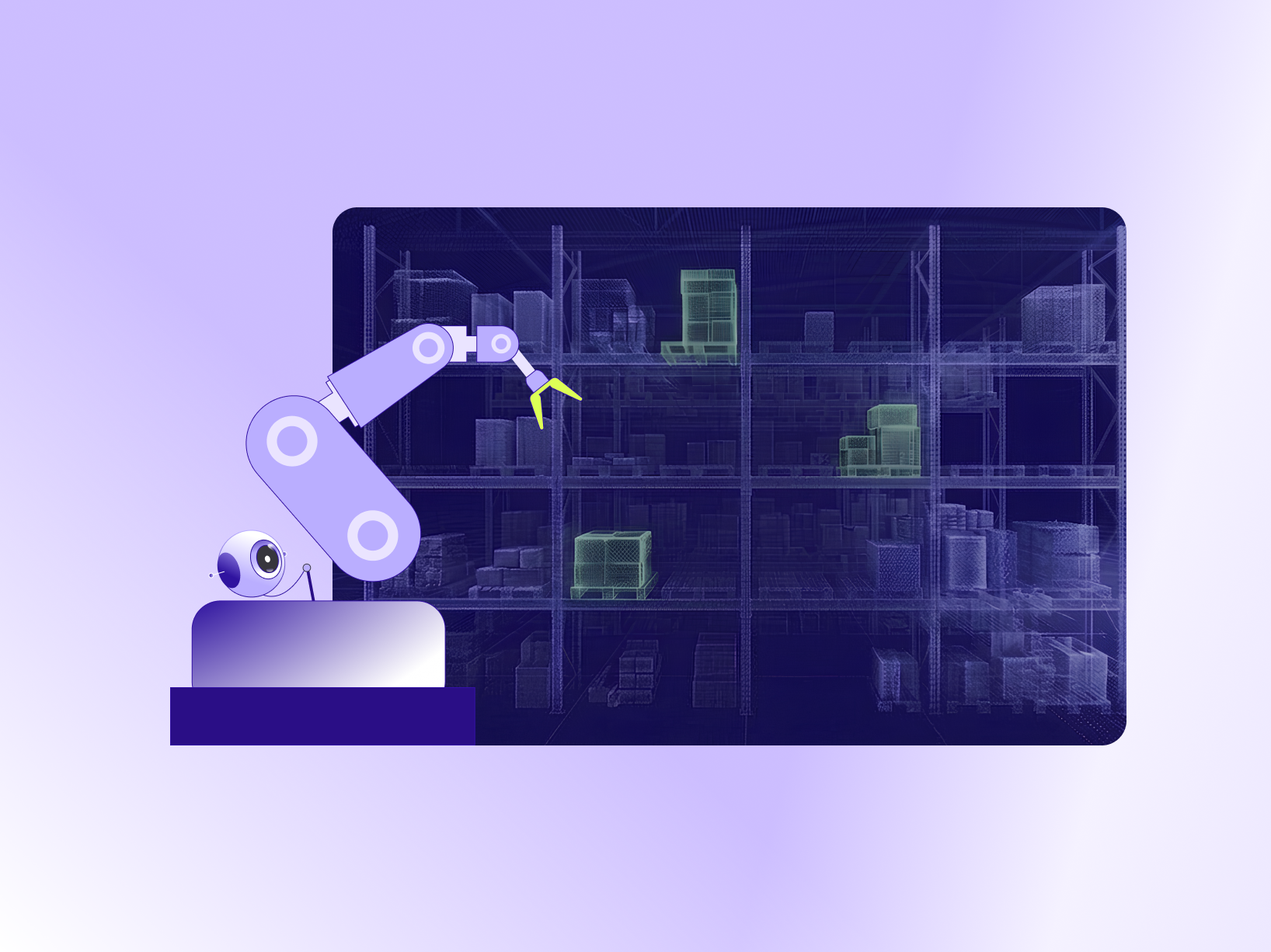
Industry: Robotics & Autonomous Systems
Use Case: Warehouse Navigation & Obstacle Avoidance
Annotation Type: 3D LiDAR Point Cloud Annotation (Semantic Segmentation & Object Detection)
Dataset Size: 680,000+ annotated point cloud frames across 15,000 warehouse scenarios
About the Client
A North American autonomous mobile robotics (AMR) company developing next-generation warehouse robots for logistics and e-commerce fulfillment centers. Their fleet of collaborative robots handles material transport, inventory movement, and order picking across 40+ warehouse facilities operated by Fortune 500 retailers and 3PLs.
Processing over 2 million pick-and-place operations monthly across 8 million square feet of warehouse space, the company's robots navigate dynamic environments with human workers, forklifts, conveyor systems, and constantly changing inventory layouts. With plans to deploy 5,000+ robots across 200+ facilities by 2027, the business needed robust perception systems capable of real-time obstacle detection and path planning in complex industrial environments.
The Challenge
What Is LiDAR-Based Autonomous Navigation?
LiDAR (Light Detection and Ranging) sensors generate 3D point cloud data by measuring distances using laser pulses, creating detailed spatial maps of the environment. For autonomous robots, LiDAR enables real-time detection of obstacles, people, vehicles, and navigable surfaces—critical for safe operation in shared human-robot workspaces. Unlike camera-based systems, LiDAR works in variable lighting conditions, through dust and steam, and provides precise depth information for path planning algorithms.
The Problem
The robotics company was experiencing rapid customer demand growth, with a 60% year-over-year increase in deployment requests from e-commerce fulfillment centers. Their existing navigation system relied on pre-mapped static environments, which broke down in real-world warehouses where layouts changed daily due to seasonal inventory shifts, temporary staging areas, and mobile equipment.
Key challenges:
- Navigation failures in dynamic environments with success rates below 78% in unmapped scenarios
- False positive obstacle detection causing unnecessary stops (12–15 per hour per robot)
- Inability to distinguish between permanent obstacles (walls, machinery) and temporary ones (pallets, humans)
- Poor performance in edge cases: reflective surfaces, transparent materials, hanging objects, low-profile obstacles
- Slow model iteration cycles (8–10 weeks) limiting response to customer-specific warehouse configurations
What Was at Stake
Without intervention, the company faced:
- Lost contracts with tier-1 customers requiring 99%+ uptime guarantees
- Safety incidents from collision risks in human-robot collaborative spaces
- Inability to scale beyond controlled, pre-mapped environments
- Competitive disadvantage as rivals deployed adaptive perception systems
- Customer churn due to frequent navigation failures requiring manual intervention
- Delayed product roadmap for multi-floor navigation and outdoor yard operations
What Didn't Work
The robotics company had tried multiple solutions before approaching Taskmonk:
- Off-the-shelf perception models — Pre-trained models from open datasets (KITTI, nuScenes) failed in warehouse environments. Trained on outdoor autonomous vehicle scenarios, they couldn't handle industrial-specific objects: pallet jacks, wire mesh cages, cardboard towers, shrink-wrapped inventory. Accuracy was below 65% for warehouse-specific object classes.
- Third-party annotation services — Generic 3D annotation platforms lacked warehouse domain expertise. Annotators mislabeled industrial equipment, couldn't distinguish between navigable gaps and blocked pathways, and produced inconsistent segmentation boundaries. Turnaround times exceeded 6–8 weeks per batch, and label quality required extensive re-work (40%+ rejection rate on QA review).
- In-house annotation by robotics engineers — The engineering team attempted to label point clouds internally using open-source tools (CVAT, Label Studio) but lacked scalable workflows for consensus reviews, multi-annotator coordination, and temporal tracking across sequential scans. The project stalled after annotating 18,000 frames over five months—far short of the 500K+ frames needed for production-grade models.
- Synthetic data generation — Simulated warehouse environments produced clean labels but models trained on synthetic data suffered from sim-to-real transfer gaps. Real-world performance dropped 20–25% compared to simulation benchmarks due to sensor noise, occlusions, and material property variations not captured in simulation.
The core challenge wasn't just annotation volume, it was domain expertise, 3D spatial reasoning, and workflow complexity for multi-class semantic segmentation across hundreds of object categories in cluttered industrial environments.
The Solution
Taskmonk designed and deployed a specialized 3D LiDAR point cloud annotation platform purpose-built for autonomous robotics applications, working closely with the company's perception team and warehouse operations experts to build training datasets optimized for industrial navigation.
What We Delivered
Phased Implementation
- Initial deploy
- ment: Semantic segmentation workflows for 12 priority object classes (floors, walls, racks, pallets, humans, forklifts)
- Workflow integration: Multi-annotator consensus, sequential frame tracking, domain expert review
- AI development: Pre-annotated datasets for object detection, semantic segmentation, and ground plane estimation
- Expanded coverage: 35+ object classes across diverse warehouse types (ambient, cold storage, hazmat, high-bay)
Multi-Class Semantic Segmentation Workflows
Custom annotation schemas for warehouse-specific object categories:
- Static infrastructure: Walls, columns, doors, loading docks, conveyor systems, racking structures
- Mobile equipment: Forklifts, pallet jacks, order pickers, tuggers, AGVs
- Inventory objects: Pallets, boxes, bins, drums, hanging garments, wire cages
- Navigable surfaces: Floor planes, ramps, transitions, restricted zones
- Dynamic obstacles: Humans (workers, supervisors), temporary barriers, staging areas
- Edge cases: Reflective surfaces, transparent materials (stretch wrap, glass), overhead hazards
3D Point Cloud Annotation Tools
- Cuboid bounding boxes for rigid objects with orientation tracking
- Polygon segmentation for irregular shapes and terrain boundaries
- Instance segmentation for multi-object scenes with occlusions
- Ground plane estimation for navigable surface detection
- Sensor fusion annotation combining LiDAR with camera data for ambiguous case
Temporal Tracking & Sequential Annotation
Point clouds from autonomous robots generate continuous sequential scans. Taskmonk's platform enabled:
- Frame-to-frame object tracking to maintain identity across temporal sequences
- Interpolation tools to propagate labels across 8–15 intermediate frames, reducing manual effort by 58%
- Motion trajectory annotation for dynamic objects (humans, forklifts) to train predictive path planning models
- Scene change detection to flag when object states shifted between scans
Consensus Review & Quality Assurance
- Blind dual-annotation on 25% of frames to establish ground truth for ambiguous objects
- Real-time inter-annotator agreement tracking (target: IoU > 0.85 for bounding boxes, mIoU > 0.78 for semantic segmentation)
- Automated quality checks: boundary consistency validation, class distribution monitoring, spatial relationship verification
- Domain expert review layer with warehouse operations specialists and robotics engineers validating edge cases
- Customer-specific calibration sessions for unique warehouse configurations and object types
Productivity-Optimized 3D Interface
- Multi-view rendering (top-down, perspective, side views) with synchronized navigation
- LiDAR intensity visualization for material property discrimination
- Keyboard shortcuts for rapid class switching and object manipulation
- Batch export to industry-standard formats (PCD, PLY, KITTI, nuScenes schemas)
- Integration with ROS (Robot Operating System) for direct pipeline ingestion
Scalable Annotation Operations
- 45-person distributed annotation team with robotics and warehouse logistics training
- Weekly calibration on new object classes and edge cases from production deployments
- Average handle time reduced from 18 minutes/scene to 6.5 minutes/scene
- 24-hour SLA on annotation requests and customer-specific workflow adjustments
The Results
Training Dataset: 11 Months
- 680,000+ annotated point cloud frames across 15,000 unique warehouse scenarios
- 35+ object classes with hierarchical taxonomy (static/dynamic, navigable/obstacle)
- Inter-annotator agreement (IoU): 0.87 for bounding boxes, mIoU: 0.81 for semantic segmentation
- Average turnaround time: 84 hours per 1,000-frame batch (~44,000 annotated frames per batch)
Model Performance
- Semantic segmentation mIoU: 86.3% across all object classes (up from 64% with off-the-shelf models)
- Object detection mAP@0.5: 91.7% for critical safety classes (humans, forklifts, mobile equipment)
- False positive rate: <6% for obstacle detection (down from 18% previously)
- Ground plane estimation accuracy: 97.2% enabling reliable path planning
- Real-time inference: 12 Hz on onboard embedded GPU (NVIDIA Jetson AGX Orin)
Business Impact (12-Month Post-Deployment)
- 92% navigation success rate in unmapped dynamic environments (up from 78%)
- 72% reduction in false positive stops improving fleet throughput
- 48% decrease in safety incidents from improved human and mobile equipment detection
- Real-time adaptation to layout changes without manual re-mapping
- Customer satisfaction: 3.4/5 → 4.6/5 with tier-1 logistics customers
Operational Efficiency
- Annotation cost per frame: $0.35 — 48% below specialized robotics annotation providers
- Model retraining cycles: 9 days (down from 8–10 weeks) enabling rapid response to customer-specific scenarios
- Successfully deployed across 40+ facilities with 15+ different warehouse configurations
- Expanded to new use cases: multi-floor navigation, outdoor yard operations, cold storage environments
3D LiDAR Point Cloud Training Data Needs
With high stakes in safety-critical autonomous navigation and the need for consistent performance across diverse warehouse environments, the robotics company required a platform enabling precise 3D spatial annotation and complex workflow management for sequential point cloud data.
To train their perception models, they prepared massive datasets (hundreds of thousands of point cloud frames) with accurate semantic segmentation, object detection labels, and temporal tracking annotations. The team created custom data workflows tailored to specific warehouse types, object categories, and edge case scenarios, generating production-grade training data while adhering to rigorous QA processes.
These workflows included consensus stages where multiple annotators labeled ambiguous objects independently, blind reads where annotators worked without seeing previous labels, domain expert review with warehouse operations specialists validating industrial-specific object classes, and automated quality checks for segmentation boundary consistency and spatial relationship accuracy.
Why Taskmonk for LiDAR Point Cloud Annotation?
The robotics company needed a training data platform that would allow them to:
✓ Set up custom 3D annotation workflows with multi-class semantic segmentation, object detection, and temporal tracking
✓ Make precise spatial annotations on high-density LiDAR point clouds (100K–300K points per frame)
✓ Handle large-scale sequential data with frame-to-frame tracking and interpolation automation
✓ Incorporate domain expertise from warehouse operations and robotics engineering teams
✓ Track annotation progress across distributed teams with real-time quality metrics
✓ Seamlessly integrate with ROS-based ML pipelines and embedded perception systems
Taskmonk met all these requirements, delivering a 3D point cloud annotation solution that balanced technical complexity with operational scalability. The team coordinated large-scale training data preparation while maintaining the production-grade quality standards required for safety-critical autonomous systems.
Taskmonk's 3D visualization tools, multi-view rendering, and keyboard-optimized workflows contributed directly to 2.8x faster annotation speeds compared to generic platforms. The robotics company has been consistently impressed with Taskmonk's domain expertise and responsiveness, with 93% of technical issues resolved within 24 hours.
With Taskmonk's LiDAR point cloud annotation platform, the robotics company has established a scalable foundation for continuous perception improvement, enabling them to deploy autonomous systems across diverse warehouse environments while maintaining safety and reliability standards.
What's Next
With proven autonomous navigation in production across 40+ warehouses, the company is expanding its perception capabilities to:
- Multi-floor navigation with elevator integration and vertical transition handling
- Outdoor yard operations for container yards and cross-dock facilities
- Collaborative manipulation with LiDAR-guided robotic arms for pick-and-place
- 5,000+ robot deployment across 200+ facilities by 2027
Taskmonk continues to support ongoing model retraining, new environment annotation (hazmat, pharmaceutical clean rooms), and edge case curation as the company's autonomous capabilities mature.
Ready to build production-grade training data for your robotics and autonomous systems?
Talk to our team →